

8 STEPS TO SANITISING AFTER THE GROCERY STORE
BY FITZ-GEORGE RATTRAY
Sanitizing after the Grocery Store
There is so much being said about the Novel Coronavirus outbreak that there is the risk of information overload, however, there are things which should never be overlooked.
As businesses are closing, supermarkets and pharmacies remain open, we need food, supplies and specifically during an outbreak we need to make sure that we have the healthy foods required to support our immune system, and if needed, support our recovery.
SUPERMARKETS ARE CONVERGENCE ZONES
Naturally, supermarkets are common convergence zones. As much as you try you are going to be within 1 meter, much less 6 to 10 feet of other people when passing in the aisles. Additionally, between any possible deep cleaning, hundreds, if not thousands of people are touching and breathing on tins, bags, boxes, produce, floor, shelves, the checkout counter, your clothing, shoes… everything.
A recent study shows that the flu virus is expelled from the lungs just in breathing It is possible that the Novel coronavirus may be spread similarly. Therefore, the minimum 1-meter social distancing is crucially important, preferably 6 to 10 feet.
HOW DO YOU MINIMIZE YOUR RISKS?
Firstly, assume that every person, every surface and every object is contaminated (even your own clothing and personal belongings). Avoid crowding and arguments, after all, do you really want someone shouting at you?
Secondly, never touch your face before you have washed your hands thoroughly.
Finally, follow the following steps, or a variation which is conducive to your transportation and household.
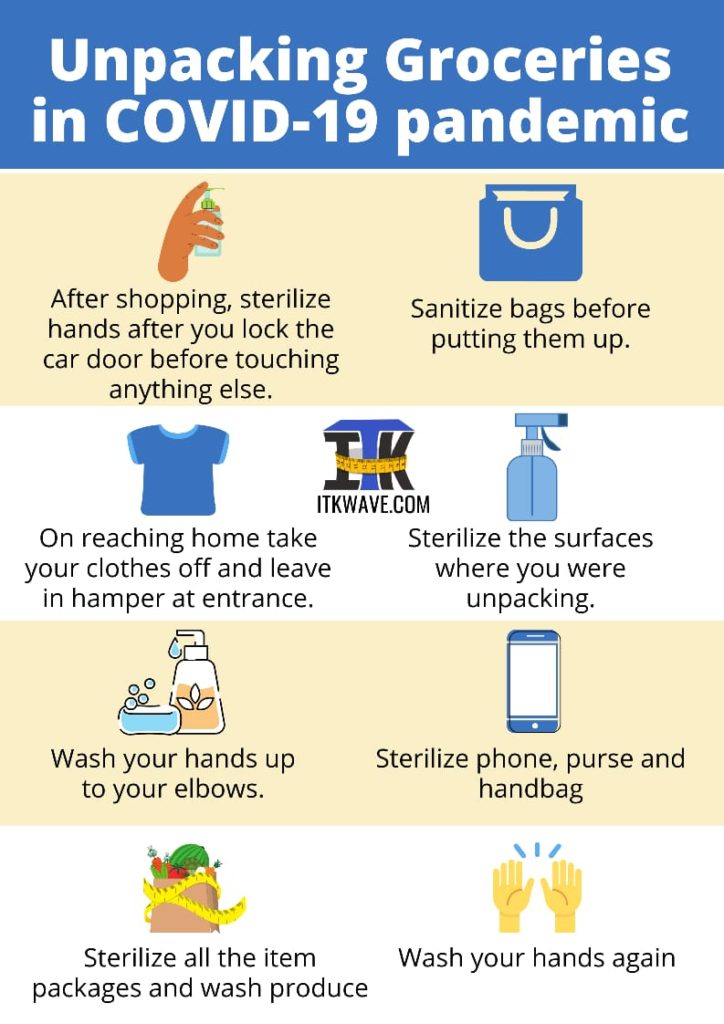
- After shopping sterilize hands after you lock the car door before touching anything else.
- Cars are semi safe feeling zones and you may wrongly, mindlessly, touch your face
- Routinely sanitize your car’s frequent touch surfaces, seat belt, steering wheel, knobs, handles, shift.
- On reaching home and bringing in the groceries, take your street clothes off and leave in a hamper at entrance or in the laundry.
- Everything entering your house including yourself should be considered contaminated
- You are absolutely likely to be at ease in your house, so, avoid the potential of contaminating objects such as knobs, switches, linen, chairs, sofas, pillows, remotes, towels etc.
- Do not shake your street clothing to avoid releasing the virus… and disinfect hamper/laundry bag between washes.
- Wash your hands up to your elbows (thoroughly, fingers and 20 seconds).
- Do not dry with your towel, use a disposable towel
- Sterilize all the item packages and wash produce
- Use a bleach based cleaner, or another proven disinfectant, to spray and wipe each package. If possible place in clean sterile zone before putting in storage. Do not dry completely before placing in cupboard, fridge, pantry or counter.
- Wash produce with soap water
- Sanitize bags before putting them up.
- Dispose of extraneous packaging, boxes or wrapping
- Your reusable bags must be sprayed with a disinfectant, inside, outside and handles (Safely wash if able), and leave in a safe place to dry and sit for up to 3 days.
- Sterilize all the surfaces where you were unpacking.
- Sterilize your phone, purse, wallet handbag and other personal items with a surface safe disinfectant
- Re-wash your hands, and take a shower, hair included if possible.
It is important to note that when you are handling packages or food which are delivered, they should be treated as contaminated. Discard all packages and place in your own containers and remember to wash your hands before eating.
We are seeing that the age ranges of critical COVID-19 patients are younger than expected in many Western Societies and the death rate is five times higher than that of the flu. Researchers are projecting that COVID-19 will be a part of humanities future, eventually everyone will be exposed. It is on you to avoid peaking the infections and overwhelming the healthcare system. It is also in your best interest to avoid the virus to the best of your ability, at least until a vaccine is available. A one out of five chance of a painful, critical, possible deadly infection is too high a risk.
Eat healthily, exercise, manage your weight and pre-existing conditions, and stay safe.






Thanks Intekai good move
Thanks. We aim to educate.